


I've been busy recently, and am just catching up with things of interest.
One of those items is the loss of the container ship MOL Comfort, which was not your ordinary sea-going vessel:
With an overall length of 316 metres (1,037 ft) long, moulded beam of 45.6 metres (150 ft) and fully laden draught of 14.5 metres (48 ft), MOL Comfort was too large to transit the Panama canal and was thus referred to as a post-Panamax container ship. She measured 86,692 in gross tonnage and 48,825 in net tonnage, and had a deadweight tonnage of 90,613 tonnes. The container capacity of the ship, measured in twenty-foot equivalent units (TEU), was 8,110 of which 4,616 TEU is stored on the deck and 3,494 TEU in the holds.
But on June 17th, while carrying 4,500 cargo containers from Singapore to Jeddah, MOL Comfort's hull cracked, and the ship separated into two pieces. The 26 crewmembers were all rescued, which itself must have been eventful, since the conditions were reported to be that "waves rose to six metres and were accompanied by strong winds."
Salvage companies responded, and at one point they had attached a tug boat to one section of the damaged ship, and were trying to tow it toward shore, but that effort ultimately failed and the entire ship was lost.
"Burnt containers and other debris are floating around the vicinity and all vessels have been advised to avoid any sea mishap," a coast guard official said.
Blog site gCaptain has collected some amazing pictures of the events here, and they've also got a nice map to help you understand where this all took place.
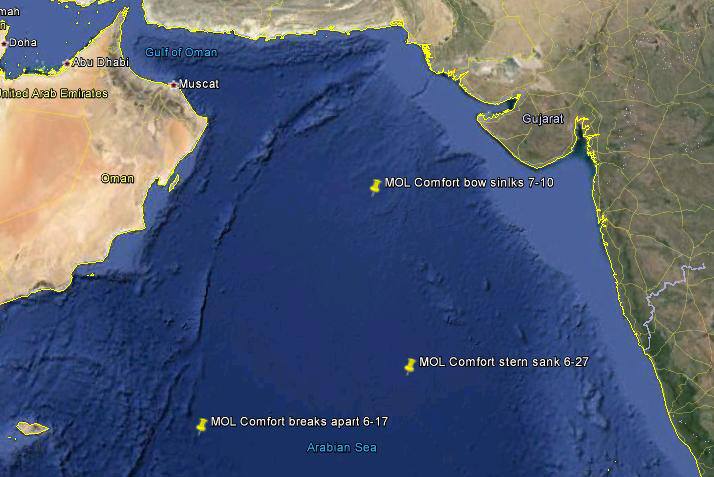
Early speculation centered on what might have caused the hull of the nearly-new ship to crack like this.
Ships are designed to handle long period and large waves that crest on the bow and stern and have a trough amidships. This creates a sagging situation that puts extreme tension on the keel and compression at deck level. The opposite, “hogging” situation occurs when the crest of the wave moves to the center of the ship and the trough of the waves are at bow and stern.The repeat flexing of the ship in these perfectly timed waves is likely what caused the loss of this vessel.
But since this is precisely what gigantic cargo container ships are designed to handle, there must have been other contributing factors. Additional speculation suggests that overloading of containers is a common situation in the shipping industry:
How on earth does a 5 year old 90,000 ton containership, built by one of Japan’s finest shipyards and operated by a tip-top liner company, come to be floating in two bits 19 miles apart? Weather? Welding?One of those 100 year waves the Met. Offices are warning us are rather more frequent?
The smart money must surely be on the stresses induced by under-declared container weights, which shippers routinely refuse to take with any seriousness whatever.
The inspection firm which oversaw the ship's construction is investigating what went wrong, and noted that they had just surveyed the ship at the end of May, and found no abnormalities. As they note with carefully chosen language, further investigation will be challenging to do, since the boat completely sank:
ClassNK, which classed the five-year old vessel, is working in conjunction with Mitsubishi Heavy Industries and Japanese government authorities to investigate the cause of the casualty. Lloyd’s Register has also been appointed to investigate the cause as a neutral third party.However, the loss of the remaining part of the hull on 11 July means investigators have much less evidence to work with. "In view of these unfortunate circumstances, the ClassNK Casualty Investigation Team will expedite the investigation into the cause of the incident, and expects to consolidate its preliminary findings by early September 2013."
"ClassNK will continue to make every effort to determine the cause of this incident, and will work to ensure that the results of the investigation are used to secure greater safety for the maritime industry," the Japanese class society added.
In the meantime, the six MOL Comfort sisterships will be retrofitted
The work, to be conducted on MOL Creation, MOL Charisma, MOL Celebration, MOL Courage, MOL Competence and MOL Commitment, will increase the vessels’ hull strength twice over, despite already meeting the International Association of Classification Societies (IACS) hull strength criteria.
This is certainly an interesting story; I'll try to pay attention to see what additional information is released as the investigators continue their study.
0 comments:
Post a Comment